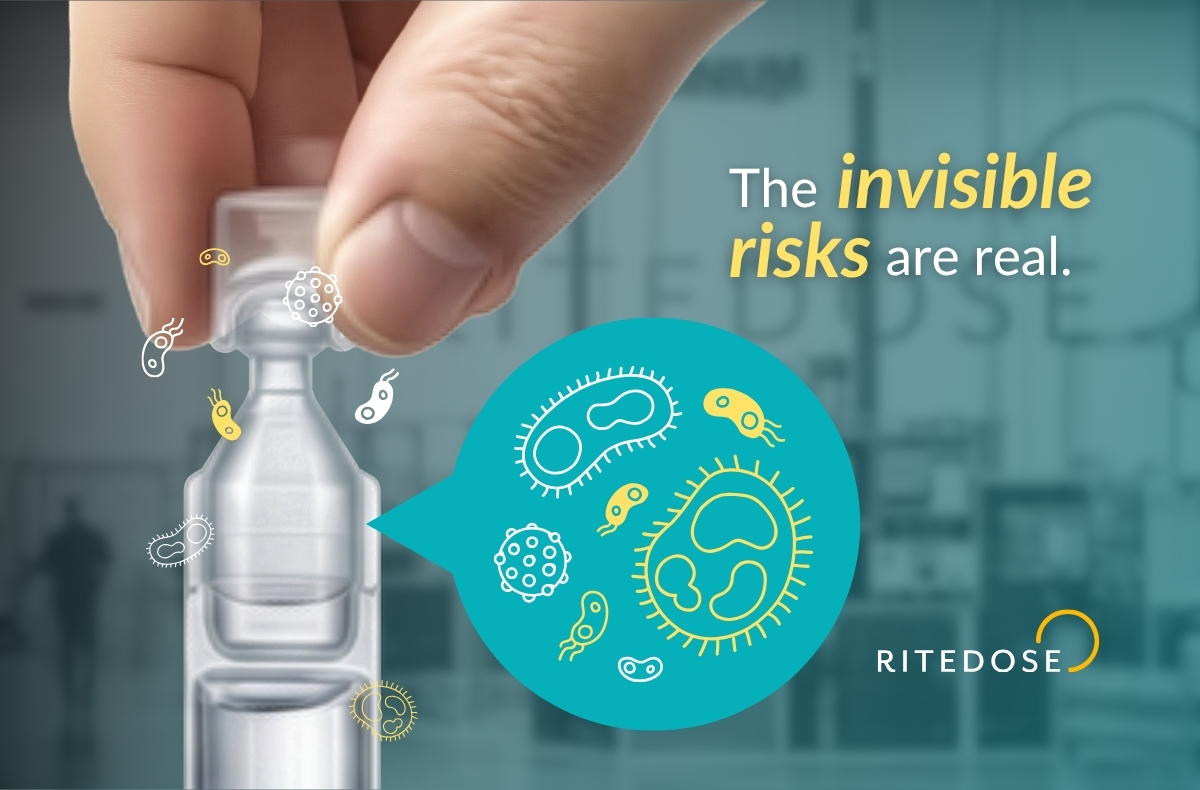
Learn how Blow-Fill-Seal manufacturing supports ophthalmic sterility and why proper handling of single-use ophthalmic products is essential to preventing microbial contamination.
Microbial Contamination is not always visible
In our previous ophthalmic blog, we made the case against reusing or resealing single-use ophthalmic medication vials. Maintaining ophthalmic sterility doesn’t end when a product leaves the manufacturing facility. Here, we explore how the contamination that makes this practice hazardous is not always something you can see.
When people think of microbial contamination, they often imagine the obvious — visible dirt, mold or other organic residue, damaged packaging or improper storage. In reality, contamination can occur through routine handling practices that appear completely harmless. It can also arise through microorganisms that are undetectable to the naked eye and identified only through sensitive instrumentation.
Understanding, preventing and detecting these contamination pathways is critical for preservative-free ophthalmic products, where the absence of preservatives removes a key line of defense against microbial growth.
Why Preservative-Free Matters in Ophthalmic Sterility
Reduced exposure to preservatives improves tolerability for many patients, leading to better outcomes — particularly for those managing chronic conditions. Demand for preservative-free ophthalmic formulations continues to grow across the industry, and for good reason. Benzalkonium chloride (BAK), the most widely used preservative in ophthalmic medications, is present in approximately 70% of preserved formulations and has well-documented evidence of cytotoxic damage to conjunctival and corneal epithelial cells.
This creates an important tradeoff. Preservatives help prevent microbial growth and protect patients from potentially serious consequences, but they can also cause their own form of damage. The answer is not simply to choose one over the other — it is to rigorously maintain proper handling procedures that make preservative-free formulations as safe as possible.
Manufacturing Supports Ophthalmic Sterility Via Blow-Fill-Seal
When considering microbial contamination risks, it is important to distinguish between contamination introduced during manufacturing and contamination that occurs after a patient opens the product.
Pharmaceutical manufacturers have invested heavily in technologies designed to minimize contamination risks before products ever reach a patient. Among the most advanced of these is Blow-Fill-Seal manufacturing.
Blow-Fill-Seal (BFS) is a multistep process in which container material — most often a specialized plastic — is heated and blown into a mold to form its shape. The cooled container is then filled with the pharmaceutical formulation and hermetically sealed. Because the entire assembly takes place within a sterile, controlled environment with minimal human contact, BFS offers significant advantages for ophthalmic products:
- Reduced opportunities for contamination during manufacturing
- Consistent container integrity across every unit produced
- Enhanced sterility assurance
- Greater process control and reproducibility
BFS ensures that ophthalmic products leave the manufacturing facility in a sterile, sealed condition.
Ritedose’s BFS manufacturing provides specific advantages for preservative-free ophthalmic products:
- Integrated container formation, filling and sealing: BFS forms plastic containers, fills them with sterile product and seals them in one continuous aseptic process, reducing the number of external handling steps between container creation and final sealing.
- Minimized human intervention: Highly controlled operations and integrated lab management systems minimize opportunities for contamination from manual processes while supporting consistent product quality and repeatable manufacturing outcomes.
- Container integrity and consistency: BFS creates each container immediately before filling, ensuring the package is produced within the same controlled environment. Consistent container quality supports reliable delivery and trusted product protection.
- Single-use delivery: BFS enables the production of unit-dose formats that support preservative-free ophthalmic therapies, helping maintain product integrity by limiting exposure after opening.
From Manufacturing to Real World Use
Throughought the manufacturing process, Ritedose’s BFS technology ensures sterility by minimizing human intervention and maintaining the most stringent aseptic conditions. BFS ensures preservative-free ophthalmic products leave the manufacturing facility with the sterility and quality patients expect.
However, when an ophthalmic product leaves our tightly-controlled manufacturing environment and arrives in the hands of patients, there are real-world contamination variables that must be considered.
Opening a single-use vial inevitably exposes the product to the surrounding environment. During administration, the squeeze-and-release action of a flexible container may draw a small amount of air back into the vial – and that air is not sterile. While this is a normal part of using the container, it illustrates why preservative-free, single-use products are intended to be discarded after use rather than kept around for later administration.
Just like air drawn back into a vial, the human body can also produce contaminants. Contact with eyelashes or the skin around the eyes can introduce bacteria to the sterile environment of the single-use vials. Again, this is why it’s critically important for the vials to be discarded after use.
When residual solution is stored and a vial is reused, even a small contamination event can escalate into a serious problem. This is why single-use preservative-free ophthalmic products are designed to be discarded after administration, even when solution remains in the vial. This must be made clear to patients.
Safety Is More Than Just the Formula
Advanced manufacturing creates the foundation for patient safety but preserving that safety is a shared responsibility.
For Ritedose, developing safe and effective ophthalmic therapies begins long before a product reaches the patient. It requires advanced manufacturing processes that protect product integrity from the moment a container is formed, while recognizing that maintaining that quality also depends on how the product is handled once it’s in a patient’s hands.
Understanding how contamination can occur after a sterile product is in the possession of patients reinforces the importance of both advanced aseptic manufacturing and patient education. Together, manufacturers, healthcare providers and patients each play a role in helping ensure preservative-free ophthalmic therapies are used as intended.
At Ritedose, the patient is our why. We live and die by that belief. That’s why we’ve significantly invested in becoming the largest BFS manufacturer in the United States. Combined with rigorous quality systems and decades of experience producing sterile unit-dose therapies, our approach helps pharmaceutical partners bring high-quality ophthalmic products to patients with confidence. Because protecting every dose begins long before a vial is opened – it begins with manufacturing excellence and a relentless commitment to patient safety.